mardi 10 juillet 2012

Liège-Guillemins - Europe's Most Impressive Railway Station

Gare de  Liège-Guillemins
In just over 2 hours after boarding the Thalys train at Gard de Nord in Paris, I arrived in Liège, Belgium at the spectacular Liège-Guillemins station. It has been described as one of the most impressive railway stations in Europe - and I would have to agree. Designed by the Spanish architect, Santiago Calatrava Valls, it was inaugurated in 2009. Nestled against a tree-covered hill, the station is described to be in the shape of a woman lying on her back. It is easy to see why with its steel, glass and white concrete, wavelike structure rises 32 metres and extends 160 metres. It may seem odd to devote a blog post to a railway station, but I really felt that it was something extra-special.


It took about 10 years to build at a cost of €312 million. As I stepped from the train on to the platform, next to the rocket from Hergé's Tintin, I had an uninterrupted view of the town of the Liège. The platforms are open having no walls, just the amazing roof structure. The shops and various services are underneath the platforms. Being in Europe, Béatrice and I did manage a to have a glass of excellent champagne at the railway station prior to my departure. I understand that the restaurant at the station is exceptionally good and has become a destination for locals when dining out. This breathtaking structure is a wonderful introduction for any visit to Belgium although I do wonder how travellers manage in the depths of winter. 


Just a brief mention regarding the service on the Thalys train. For an extra 5€, I opted to travel first class on the train from Paris to Liège. Normally I would not bother with travelling first class as I find trains in France to generally be excellent. I thought however it was worth trialling first class. The seating is a configuration of 2 + 1 so I was able to request a seat by itself giving me the advantages of both being next to the window as well as the aisle seat. Parfait! In addition I also was offered both at lunch and dinner times a three course meal including cheese as well as wine, tea and coffee. The meal was not exceptional - but it was certainly adequate for the brief journey. WiFi is available on the train and is free in first class.


I will certainly check out the inclusions and compare the prices for future trips. The staff were very friendly and swapped effortlessly between French, German and English. I wouldn't be surprised if they also spoke Flemish. They went out of their way to make the trip pleasant. We were also given the option of booking a taxi for our arrival. The pleasant service started at Gare de Nord when I first queried with one of the staff about composting my 'printout' and continued for both the forward and return journeys. Congratulations to the Thalys staff.
If you are interested in a 3D view of the Liège-Guillemins railway station check out: http://www.outline.be/stereo/Guillemins3D/

lundi 9 juillet 2012

Visiting the Belgian Countryside: Spa and Lac de Warfaaz

Villa Marie-Henriette (houses local museums)
Béatrice, with whom I have been staying near Liège, suggested a visit to the pretty town of Spa.  Surrounded by hills and a dense forest, the Pearl of the Ardennes is not only known for its healing, iron containing water sources but also for its proximity to the Belgian Grand Prix and Les Francopholies de Spa. The francopholies is a music festival promoting francophone music. Unfortunately we were a week too early for this festival. Instead we were greeted by the thump, thump of a techno music festival. Not exactly the quiet atmosphere we were expecting. 


Asbestos covering side of buildings
Many of the homes in and around Belgium have the distinctive diamond shaped covering on the external walls. I am informed that they are made from asbestos and are designed to prevent moisture entering the house.

Staircase next to the casino (oldest casino in the world)
Pouhon Pierre-le-Grand
This building houses one of the water-sources. Unfortunately it was closed due to the music festival so we were unable to fully visit it. 

Former Tourism Office in Spa
Deciding to leave the thump, thump behind in Spa we headed for Lac de Warfaaz. The lake is the result of a barrage built in 1892. Historically bourgeois families would travel from Spa in their horse-drawn carriages and then do a tour around the lake. It is now a destination for fishermen looking for trout and salmon as well as people wanting to enjoy the beautiful setting. The lake is surrounded on one side by a steep forested hill with the occasional chateau visible. Again we did not get to enjoy the promised tranquility of such an idyllic spot. Instead we were greeted by children on a holiday camp who were enjoying water activities along with the usual associated skylarking. We managed to console ourselves with a glass of champagne by the edge of the lake before heading back to Liège with the car rooftop down enjoying the sunshine. 
Beautiful old glass-house near to Lac de Warfaaz.
Lac de Warfaaz

samedi 7 juillet 2012

Crossing the border to visit Maastricht (Netherlands)


Coming from Australia I am constantly amazed at how easy it is to go from one country to another. We drove the short distance from Rotheux, near Liège in Belgium, to Maastricht on the banks of the Meuse River. 


Of course Maastricht is well known for its relationship with the European Union Treaty. Undeterred by this important role, my focus this time was on shopping and cafés. The sales are not only on in France but were certainly evident in Maastricht. 


First stop was lunch at charming café, Café d'Artagnan, where I thoroughly enjoyed my prawn croquettes served with salad and probably the best chips I have ever eaten. I don't often eat chips but these were excellent - crispy on the outside and fluffy on the inside (served of course with mayonnaise).  The prices for food and drinks were quite reasonable and a relief after Paris prices.


It was time then to do some window-shopping. There were lots of high end fashion shops, beautiful jewellery and homeware shops. Unfortunately our time was quite limited so I can't recommend particular stores. Regrettably I came away empty-handed.

Overall I was most impressed by the architecture, cobble-stoned streets, cafés and the stores in Maastricht. It had a laid-back relaxing feel about it and was very clean and well maintained. I definitely would like to go back to explore it in greater detail perhaps spending a couple of nights as well.


Grand café d'Artagnan
Graanmarkt 3 6211 HG Maastricht, Netherlands

mercredi 4 juillet 2012

Tilff (Belgium)

Tilff is a pictoresque village not far from Liège in the French-speaking part of Belgium. It is located on the banks of the Ourthe River. We dined at Le Canotier - a popular restaurant amongst locals and visitors and visitors alike. I chose the boulets à la liegoise (pork and beef meatballs with sirop à Liège and raisins) followed by café liégois. The boulets, sauce and accompanying salade and chips (it is Belgium) were all excellent. Tasty and not too heavy or fatty. I expected the café liégois to be coffee flavoured ice-cream with cream but instead it was thick icy cold drink that I think included coffee, ice-cream and cream. Definitely not low-fat.

Ourthe River, Tilff


Le Canotier Tilff
4, place du Roi Albert
4130 Tilff Belgium

vendredi 22 juin 2012

Normandy Châteaux seen from the Air

Despite what some people may think, châteaux are not limited to the Loire Valley. In a very short time frame I was able to see some amazing châteaux in Normandy from the air.
Château de Beaumesnil
Château de Beaumesnil: The current château was built between 1633 and 1640. It is considered an excellent example of Louis XIII architecture. It is situated 135 km west of Paris. It is possible to visit the interior and the French formal gardens. It is also well-known for its collection of ancient bookbindings. 

Château du Champs de Bataille
Some say that the present owner of the Château du Champs de Bataille, Jacques Garcia, is trying to construct a garden in line with Versailles. Certainly from the air it was a very impressive site.


Château d'Harcourt
The medieval Château d'Harcourt was constructed between the 12th and 14th centuries. The château has retained some of its medieval architecture which bears testament to its defensive role in the 14th century. In the 17th century the role of the château changed and it was all about pleasure. The eastern façade shows the classical architecture of this period. The moats have been filled in and the terrace now leads to a parterre rather than the earlier French garden.
Abbaye du Bec-Hellouin

Château de Beaumesnil
2 Rue des Forges 27410 Beaumesnil

Château du Champs de Bataille
Place du Château 27110 Le Neubourg

Château d'Harcourt
Domaine d'Harcourt 13 Rue du Château, 27800 Harcourt


dimanche 17 juin 2012

Loire Valley Wine Dégustation

Fraussie, with whom I have been staying in Blois at Closerie Falaiseau, suggested that we do a wine dégustation at Vinomania in Blois. Knowing that my wine knowledge was very poor, I was only too happy to agree. Friday evenings whilst the locals were making their way to bars to watch the latest football match we headed to the wine bar come restaurant. Virginie, our effervescent, knowledgeable sommelier, tailored a three hour comprehensive session for us in English that covered information about the various production areas in the Loire Valley, history of the winemaking in the area and the methodology of wine tasting.  


Being an absolute novice about wine there was so much that was new to me. I was comforted to know that I am not the only one who tends to panic when wine tasting feeling pressured to identify 'correctly' the smells and tastes. Most reassuring and liberating to be told that it really comes down to perception and what I think or taste is not necessarily right or wrong.  


I didn't know that the very first sense when tasting wine is not sight, but in fact hearing. As the wine is poured we are already making judgements about the density and whether it is sparkling or flat. We then looked at the visual clues the wine provides and then progressed through first, second and third nose. Finally we got to taste, first time spitting out and the second time swallowing. It was particularly interesting to talk about how we first detect the smell and then afterwards our brain works at recognising the smell based on our memories and experiences. Fraussie most impressively could pick the wines. I however was just content to recognise that there was something amiss with one of the wines. It appears that I need to do a lot of homework to establish reference points for tasting wines. What better place to do it than in France?

If you are looking to develop or enhance your wine tasting knowledge then I highly recommend Virginie at Vinomania in Blois, although the private sessions at 120 € for two people are not cheap.

Vinomania
12, rue du Poids du Roi
41000 Blois
Tel: +33 2 54 90 17 66

samedi 16 juin 2012

Château de Blois - Four Architectural Styles

The Château de Blois is centrally located in Blois, easily accessible from the railway station. It is rather unusual in that it has 4 distinct wings arranged around a central courtyard. Each wing has its own architectural style making it an especially interesting place to visit if you want to look at different aspects of architecture over time. 

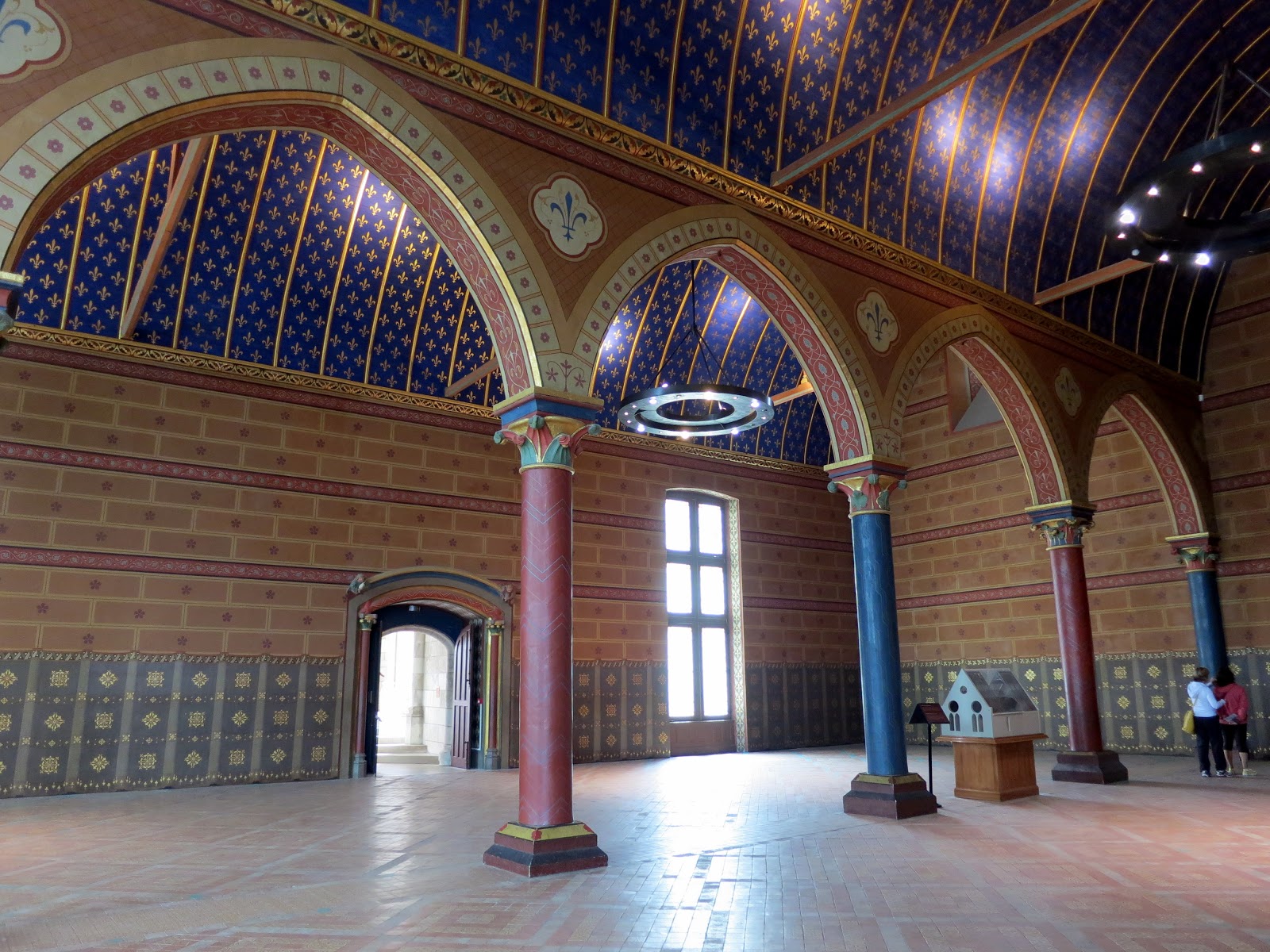
The seignorial hall was a part of the medieval fortress and is the largest 13th century Gothic hall in France.  
Gothic seignorial hall

The Louis XII wing (1498 - 1503) is built in the flamboyant style and now houses the Blois Musée des Beaux Arts (Fine Arts Museum), the ticket office and the château's giftshop. I didn't even realise that bricks were used in buildings dating back this far.

Flamboyant Louis XII wing (1498 - 1503)
The François I wing (1515-1524) is built in the renaissance style. Its magnificent external spiral staircase is the feature that for many people is the symbol of this château. The royal apartments have been restored and if my French is correct, only one of the rooms contains the original decoration from that time. All of the restorations have been beautifully done and really do give a good indication of how life would have been in the 16th century.

Renaissance François I wing (1515-1524)


The last wing of the château is the Gaston d'Orléans wing (1635 - 1638) in the classical style. Unfortunately I didn't get to visit the inside with its famous cupola.
Classical Gaston d'Orléans wing on left next to the renaissance François 1er wing


Louis XII crest

Château de Blois
6, Place du Château
41000 Blois, France
Tel: + 33 2 54 90 33 33
Fax: + 33 2 54 90 33 31
Related Posts Plugin for WordPress, Blogger...