vendredi 22 juin 2012

Normandy Châteaux seen from the Air

Despite what some people may think, châteaux are not limited to the Loire Valley. In a very short time frame I was able to see some amazing châteaux in Normandy from the air.
Château de Beaumesnil
Château de Beaumesnil: The current château was built between 1633 and 1640. It is considered an excellent example of Louis XIII architecture. It is situated 135 km west of Paris. It is possible to visit the interior and the French formal gardens. It is also well-known for its collection of ancient bookbindings. 

Château du Champs de Bataille
Some say that the present owner of the Château du Champs de Bataille, Jacques Garcia, is trying to construct a garden in line with Versailles. Certainly from the air it was a very impressive site.


Château d'Harcourt
The medieval Château d'Harcourt was constructed between the 12th and 14th centuries. The château has retained some of its medieval architecture which bears testament to its defensive role in the 14th century. In the 17th century the role of the château changed and it was all about pleasure. The eastern façade shows the classical architecture of this period. The moats have been filled in and the terrace now leads to a parterre rather than the earlier French garden.
Abbaye du Bec-Hellouin

Château de Beaumesnil
2 Rue des Forges 27410 Beaumesnil

Château du Champs de Bataille
Place du Château 27110 Le Neubourg

Château d'Harcourt
Domaine d'Harcourt 13 Rue du Château, 27800 Harcourt


dimanche 17 juin 2012

Loire Valley Wine Dégustation

Fraussie, with whom I have been staying in Blois at Closerie Falaiseau, suggested that we do a wine dégustation at Vinomania in Blois. Knowing that my wine knowledge was very poor, I was only too happy to agree. Friday evenings whilst the locals were making their way to bars to watch the latest football match we headed to the wine bar come restaurant. Virginie, our effervescent, knowledgeable sommelier, tailored a three hour comprehensive session for us in English that covered information about the various production areas in the Loire Valley, history of the winemaking in the area and the methodology of wine tasting.  


Being an absolute novice about wine there was so much that was new to me. I was comforted to know that I am not the only one who tends to panic when wine tasting feeling pressured to identify 'correctly' the smells and tastes. Most reassuring and liberating to be told that it really comes down to perception and what I think or taste is not necessarily right or wrong.  


I didn't know that the very first sense when tasting wine is not sight, but in fact hearing. As the wine is poured we are already making judgements about the density and whether it is sparkling or flat. We then looked at the visual clues the wine provides and then progressed through first, second and third nose. Finally we got to taste, first time spitting out and the second time swallowing. It was particularly interesting to talk about how we first detect the smell and then afterwards our brain works at recognising the smell based on our memories and experiences. Fraussie most impressively could pick the wines. I however was just content to recognise that there was something amiss with one of the wines. It appears that I need to do a lot of homework to establish reference points for tasting wines. What better place to do it than in France?

If you are looking to develop or enhance your wine tasting knowledge then I highly recommend Virginie at Vinomania in Blois, although the private sessions at 120 € for two people are not cheap.

Vinomania
12, rue du Poids du Roi
41000 Blois
Tel: +33 2 54 90 17 66

samedi 16 juin 2012

Château de Blois - Four Architectural Styles

The Château de Blois is centrally located in Blois, easily accessible from the railway station. It is rather unusual in that it has 4 distinct wings arranged around a central courtyard. Each wing has its own architectural style making it an especially interesting place to visit if you want to look at different aspects of architecture over time. 

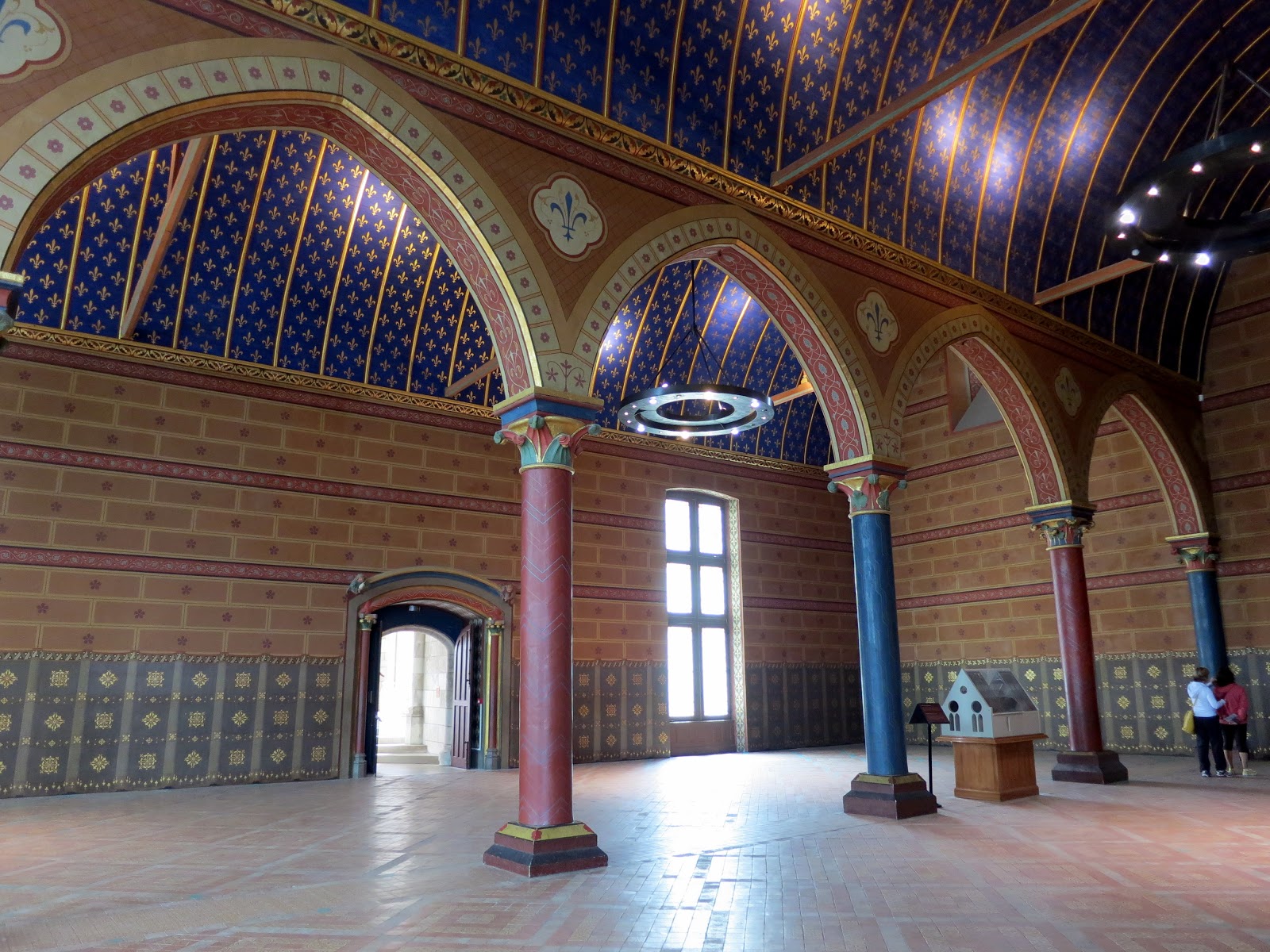
The seignorial hall was a part of the medieval fortress and is the largest 13th century Gothic hall in France.  
Gothic seignorial hall

The Louis XII wing (1498 - 1503) is built in the flamboyant style and now houses the Blois Musée des Beaux Arts (Fine Arts Museum), the ticket office and the château's giftshop. I didn't even realise that bricks were used in buildings dating back this far.

Flamboyant Louis XII wing (1498 - 1503)
The François I wing (1515-1524) is built in the renaissance style. Its magnificent external spiral staircase is the feature that for many people is the symbol of this château. The royal apartments have been restored and if my French is correct, only one of the rooms contains the original decoration from that time. All of the restorations have been beautifully done and really do give a good indication of how life would have been in the 16th century.

Renaissance François I wing (1515-1524)


The last wing of the château is the Gaston d'Orléans wing (1635 - 1638) in the classical style. Unfortunately I didn't get to visit the inside with its famous cupola.
Classical Gaston d'Orléans wing on left next to the renaissance François 1er wing


Louis XII crest

Château de Blois
6, Place du Château
41000 Blois, France
Tel: + 33 2 54 90 33 33
Fax: + 33 2 54 90 33 31

vendredi 15 juin 2012

Domaine de Chaumont-sur-Loire's International Garden Festival


The Domaine de Chaumont-sur-Loire covers an area of approximately 32 hectares and is located between Blois and Tours in the Loire Valley. 
The Domaine de Chaumont-sur-Loire is the foremost Centre for Art and Nature entirely devoted to the relationship between nature and culture, artistic creation and the impact of landscape, our heritage and contemporary art. 
The Domaine not only includes the Château de Chaumont-sur-Loire (15th to 19th century), its gardens and parks, but also from April to the end of October, the stunning International Garden Festival. In addition, there are many exhibits and installations by contemporary artists.

Château de Chaumont

The château makes an impressive sight as it sits high up overlooking the Loire River. While I was impressed by its location and appearance on the outside, I was not overly impressed by the interior and would not recommend it as a must see amongst châteaux. Having just visited the Château d'Amboise and the Château de Blois, I found that this château did not offer any thing extra. The 'Ailleurs, ici' exposition of stained glass windows by Sakris I found rather repetitive, disjointed and tedious.

Château de Chaumont-sur-Loire
I particularly enjoyed the Children's Garden area, the Domaine potager and the International Garden Festival. This Festival has been running since 1992 and this year attracted more than 300 applicants for the coveted 30 places. Applicants are attracted by the prestige of displaying their work and the opportunity to have their work noticed on not just a national but also an international level. Successful applicants are given 11,000 € to help them with their costs executing their displays. Unlike many other garden competitions they have to have their display on show for a greatly extended period, from April to end of October. They do not get a choice of plots so it really is up to them to meet any challenges that the site may present. Some exhibitors do attract additional outside sponsors which goes someway to defraying their costs. Each year the competition has a theme and this year it is: Gardens of delights, gardens of delirium. Free tours are provided in both French and English of a selection of the exhibitors. I found the tour extremely helpful as it explained the creative thinking behind many of the exhibits and also gave additional information about the plants etc. I would never have know that there is a plant that when you gently rub its leaves, the smell is just like the smell of a barbecue.

Paradis terrestre / Mag mell - Part of International Garden Festival
When buying lunch at Domaine de Chaumont-sur-Loire I found that the 2 snack bars which had a choice of 4 rolls with fillings ran out very quickly. Seating was also limited. There was a very nice gastronomic restaurant, Le Grand Velum, which had formules starting at 28€ for main course, café gourmand (coffee with samples of sweet offerings) and a glass of wine. It was more than I was prepared to pay on top of the 15,50 entry fee for the Château, International Garden Festival and grounds. It was not possible to see the 16,50€ buffet with pasta main course so I can't tell you whether it represented good value or not. 

Installation in the garden


In spite of spending more than 5 hours visiting the site I disappointingly didn't get around to the many installations in the garden so I can't tell you about them.

The International Garden Festival, grounds and the outside of the château do make the overall site a definite must see in the Loire Valley. I do however recommend just buying the ticket for the International Garden Festival which will also give you access to the grounds (11€) and skip paying the extra to include the internal visit to the château and stables (15,50€). A discount is offered if you have a train ticket to Onzain for the day of your visit. 

Tip: If you want to avoid the long (albeit pretty) walk up the hill to the site, then access the site through the southern entrance (Entrée sud).

41150 Chaumont-sur-Loire
Tél. : 02 54 20 99 22 
Fax : 02 54 20 99 24
contact@domaine-chaumont.fr


jeudi 14 juin 2012

Ideal Rental Accommodation for Couples Visiting the Loire Valley


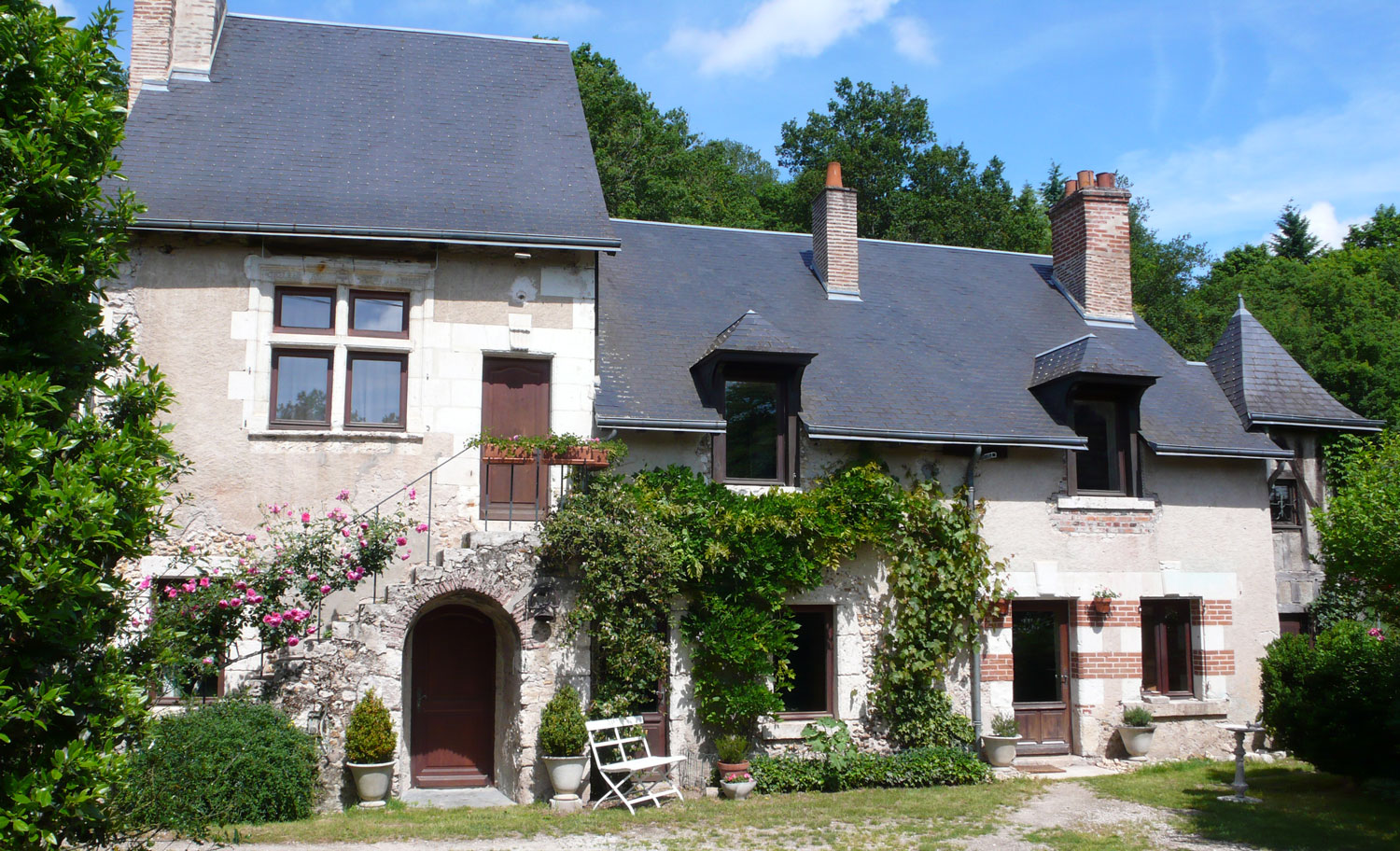
I am so very fortunate to have been invited to stay with Fraussie from the Aussie in France blog at her Loire Valley home, Closerie Falaiseau. Only one hour 20 minutes from Paris by train, the house constructed in 1584 (this is older than settlement in Australia!!!) is conveniently located in Blois making it ideal for visiting the châteaux in the region. The closest bus stop is a very pleasant 10 minute walk from the house and the picturesque ride into the centre of Blois takes about 10 to 15 minutes. It was quite straightforward taking the bus to visit the Château Royal de Blois. The bus driver chatted away to me about my impressions of Blois and explained in detail the best way to access the château. To visit the Château Royal d'Amboise I borrowed Fraussie's car but it is possible to get there by train. Tomorrow I am hoping to visit the Château Chaumont-sur-Loire. Chenonceau, which I have previously visited, and Chambord are also readily accessible by car from Blois. If you don't have a vehicle you can still visit towns such as Amboise, Tours, Saumur and Orléans by train and there is a châteaux shuttle bus (Navette des Châteaux) serving Blois, Chambord, Cheverny and Beauregard. 
Enormous bedroom at Closerie Falaiseau
Closerie Falaiseau provides the best of all worlds. It is only 5km from the centre of Blois and yet it has the benefits of being in the countryside. It is situated not far from the banks of the Loire River and backs on to a small wood. My bedroom, which looks out on to the enclosed garden, is very generously proportioned with its own entrance and ensuite bathroom. I am extremely fussy about accommodation but Closerie Falaiseau ticks all the boxes. It has a 'proper' shower not just one of those handheld sprays in a bathtub that some French people call a shower. Bathrobes and hairdryer are provided. The towels are soft and fluffy. One of my pet gripes are those tiny thin scratchy bits of rag that some owners think are adequate as towels for their guests. The sheets are luxurious, fine cotton and the bed and pillows are all very comfortable. No lumps, bumps or sagging bits here. There is ample hanging room in the large mirrored wardrobe (with lots of coat-hangars) as well as plenty of drawers for other items. Bedside lighting and plenty of powerpoints for recharging all my electronic bits and pieces are thoughtfully provided. Fraussie provides all the little things that guests appreciate and ensures that everything is spotless.
View of bedroom looking towards front of house
The private lounge area is equipped with computer, tourist brochures and books. WiFi is also provided and I found works very quickly. The lounge area leads on to the dining area and well-equipped kitchen. It is easy to see that Fraussie and her husband Relationnel are keen cooks. Unlike some self-catering accommodation places in France, the knives are sharp, there are lots of chopping boards, herbs and spices, bowls, frypans etc.

Lounge room
If you are looking for a base to visit the Loire Valley I definitely recommend Closerie Falaiseau in Blois. The lower part of the cottage is available to rent and is ideal for a couple, providing plenty of room in which to relax and enjoy yourselves.

Fraussie in the dining room
Accommodation:

To do:

mercredi 13 juin 2012

Belleville and its Street Art

When visiting Belleville in Paris recently, Hidden Secrets of Belleville, I was really interested in the street art that was to be found everywhere.
Artwork by Némo (a Parisian stencil artist whose works are often characterised by the black outline of a man in a raincoat wearing a hat). More artworks on Flickr
Artist unknown
Jerôme Mesnager (friend of Némo) More art works on Flickr
Il faut se méfier des mots, Ben (1993) - Beware of Words
The trompe l'oeil above and the fresco below are on the same street corner in Belleville.

Mural of detective by Jean Le Gac. 
Created using mixture of paint and newspapers by Philippe Hérard  

mardi 12 juin 2012

Hidden Secrets of Belleville

You would think that with a name like Belleville, which translates into English as 'beautiful town', this would be one of the prettiest areas in Paris. For Parisians Belleville has a somewhat seedy reputation. Although it definitely has a certain amount of grittiness from its working class roots it also has a charm. Its charm is in its authenticity which is punctuated with numerous unexpected pockets of beauty and pleasant surprises. The contrast of these elements really accentuates the hidden beauty of the area. 
  

Belleville has not always been a part of Paris. It was originally an area with vineyards and farms. Today a few vines can still be seen in the area. In the eighteenth century there was a huge growth in cabarets and dance halls (guinguettes). Food and wine were exempt from taxes at this time so many bourgeois people travelled from Paris to let their hair down and have a good time. These days the area is home to people from a diverse range of ethnic backgrounds, including Asian, Arab and Jewish. It includes the second of Paris' Chinatown districts, the other being in the 13th arrondissement. With its relatively low rents it has also attracted many artists who have established studios in the area. Belleville has maintained its anti-establishment roots which are evidenced in the street art and slogans found in the area.


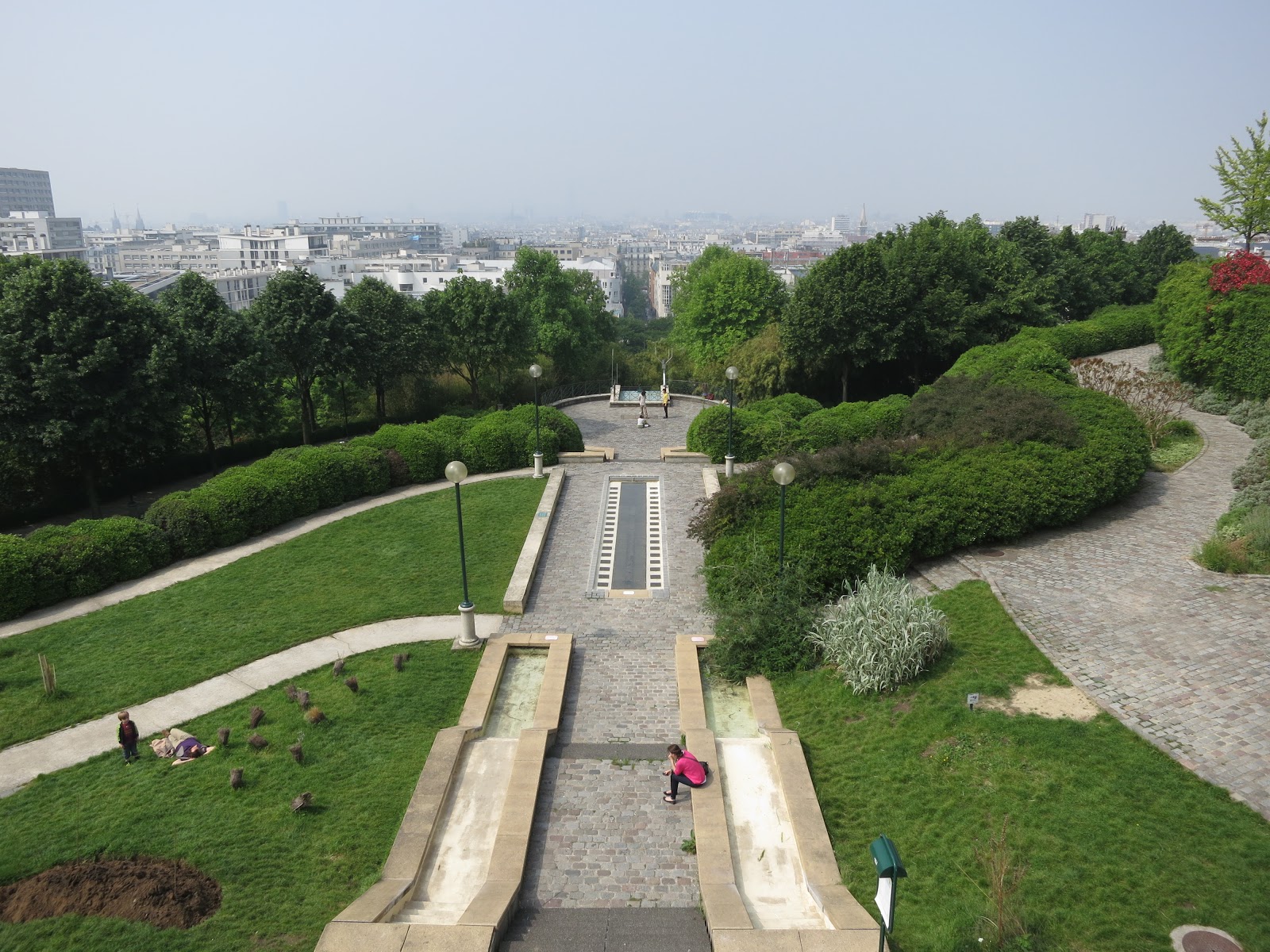
The Parc de Belleville offers panoramic views over Paris. To make the most of your visit to the garden and its views, try to schedule your visit for a clear day.  


If you are on an Edith Piaf pilgrimage then you will want to stop by the commemorative plaque at 72, rue de Belleville where legend has it she was born.


I had a sense of having previously visited the area. Many films have been shot in Belleville including Monsieur Ibrahim et les fleurs du Coran and Le Ballon Rouge (The Red Balloon). Both of these films I had seen and obviously their images had remained with me.


I was fortunate to discover Belleville with my wonderful guide Alain from 'Parisien d'un jour - Paris Greeter'. I previously did a tour of Le Sentier with him and which I recounted in my post Free Walking Tours with Parisian Volunteers. If you are planning on visiting Paris and want to do a walking tour I recommend registering online with 'Parisien d'un jour - Paris Greeter' as soon as you know your preferred dates and times, and at least a few weeks beforehand.

Parc de Belleville: 47, rue des Couronnes, PARIS 75020
Related Posts Plugin for WordPress, Blogger...